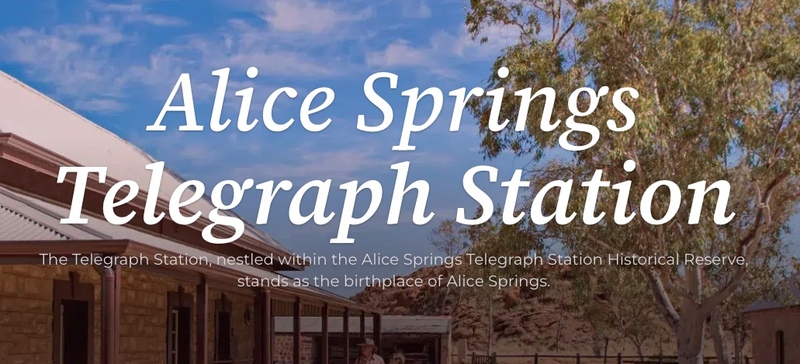
Where Australian Communications Changed Forever – The Alice Springs Telegraph Station
Date :
05 /
08 /
2026
Author :
Standing quietly on Arrernte Country just north of Alice Springs is one of Australia's most important communications heritage sites. The Alice Springs Telegraph Station, established in 1871 as part of the Overland Telegraph Line, became the vital link that connected the Australian colonies to each other and, for the first time, to the rest of the world. Before the line was completed, a message to England could take months by sea. Afterwards, the same message could be transmitted in as little as five hours, a revolutionary achievement that transformed Australia's place in the world.
The driving force behind this remarkable engineering project was Sir Charles Todd, South Australia's Postmaster-General and Government Astronomer. Todd was much more than an administrator. He was a scientist, surveyor, astronomer and engineer whose work helped shape Australia's communications infrastructure. The Overland Telegraph followed the route pioneered by explorer John McDouall Stuart, with construction beginning in 1871 and the final connection completed on 22 August 1872. The line stretched more than 3,000 kilometres between Port Augusta and Palmerston (now Darwin), where it connected to the undersea cable network linking Australia with Asia and Europe. At the time, it was regarded as one of the greatest engineering achievements of the nineteenth century.
The Alice Springs Telegraph Station was one of twelve repeater stations along the route, operating around the clock with telegraphists relaying Morse code traffic day and night. The station became the centre of settlement in Central Australia and ultimately gave birth to the township of Alice Springs itself. Today, visitors can walk through beautifully restored stone buildings, view period equipment and learn how the telegraph station later became an important chapter in the history of Central Australia.
For amateur radio operators, this history holds a special significance. The rhythmic clicks of the Morse key that echoed through the station more than 150 years ago are still heard at the telegraph station and on the amateur bands today. Across Australia, dedicated "Morsecodians" and radio amateurs continue to preserve and promote Morse code, not simply as a nostalgic operating mode, but as an efficient, reliable and internationally recognised communications skill. CW remains one of the most spectrum-efficient modes available and continues to be used in contesting, DXing, portable operations and weak-signal communication.
The over 116 year old Wireless Institute of Australia has long recognised the importance of preserving our communications heritage while encouraging new generations to discover the science and skills behind radio communication. Many affiliated clubs offer Morse training, operating nights and mentoring programs that ensure this historic mode continues to thrive alongside today's digital technologies.
If you find yourself travelling through Central Australia, the Alice Springs Telegraph Station is well worth a visit. It is far more than a museum. It is the birthplace of Alice Springs, a monument to Australian scientific ingenuity, and a reminder that today's global communications networks were built on determination, engineering excellence and the simple elegance of Morse code.
For more information or to plan a visit, see the Alice Springs Telegraph Station website - Link
Page Last Updated: Tuesday, 04 Aug 2026 at 21:55 hours by Justin Giles-clark
Click Here To Return To Previous Page
|