RADE: Australian Amateur Radio Innovation Takes Digital Voice in a New Direction
Date :
05 /
10 /
2026
Author :
WIA
An amateur radio digital voice project with strong Australian roots is pushing the boundaries of what can be achieved with machine learning, digital signal processing and HF radio.
The FreeDV Project develops a suite of completely open-source digital voice modes for amateur radio. Its flagship technology is now RADE, the Radio Autoencoder, a radically different approach to transmitting speech over difficult HF channels. FreeDV says RADE combines machine learning with classical DSP to deliver high-quality speech at signal-to-noise ratios as low as -2 dB.
At the heart of the project is Australian radio amateur and engineer David Rowe VK5DGR, well known internationally for his work on Codec 2 and FreeDV. The RADE concept emerged from discussions between David and codec developer Jean-Marc Valin in late 2023. Valin produced an initial proof of concept, and during 2024 David developed the idea into a practical waveform capable of carrying speech over real HF radio channels.
Machine Learning Meets HF Radio
What makes RADE particularly interesting is that machine learning isn't merely being bolted onto a conventional digital voice system. It is being used as part of the communications system itself.
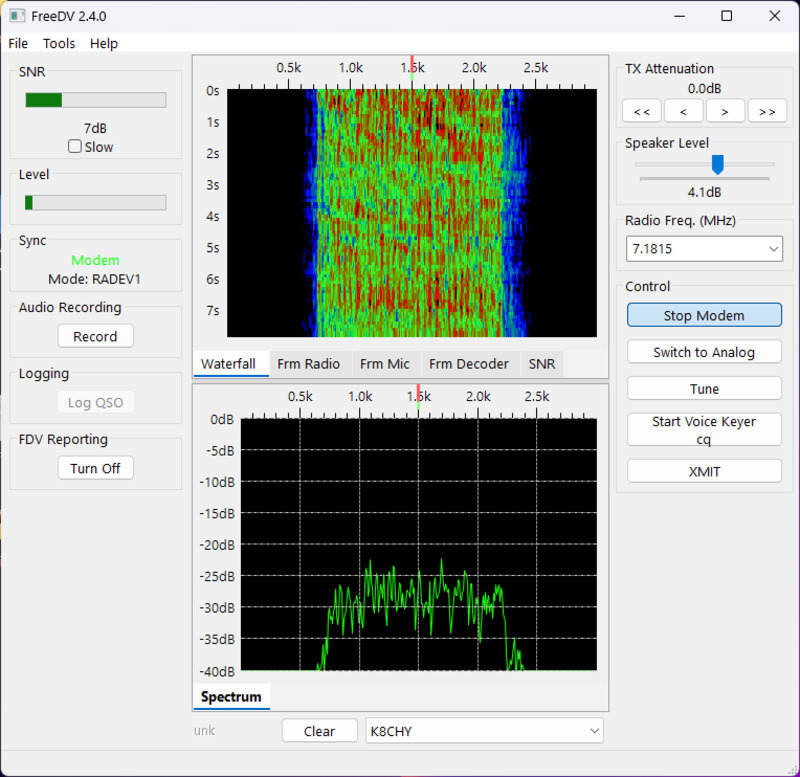
RADE V1 carries speech with an 8 kHz audio bandwidth in just 1500 Hz of RF bandwidth. FreeDV reports a peak-to-average power ratio of around 4 dB through a typical SSB radio filter, allowing efficient use of an amateur transmitter's power amplifier. Controlled testing and two years of real-world operation have shown impressive speech quality under both high and low SNR HF conditions.
Better still for experimenters, you don't need a specialised proprietary radio to try it. FreeDV can use an ordinary SSB transceiver connected to a Windows, Linux or macOS computer, with RADE integrated into FreeDV-GUI. A typical PC or Raspberry Pi 4 or better has sufficient resources for RADE V1.
From an Australian Project to an International Team
While David VK5DGR continues to lead the project's signal-processing work, FreeDV has grown into a genuinely international amateur radio development effort.
Mooneer Salem K6AQ maintains and extends the FreeDV GUI and has handled RADE integration. Peter Marks VK3TPM introduced the use of agentic AI to accelerate the conversion of RADE's reference Python implementation into C. The FreeDV Project Leadership Team also includes Walter Holmes K5WH, Mel Whitten K0PFX and Brian Morrison G8SEZ, alongside David, Mooneer and Peter. Many other amateurs around the world contribute development, testing and technical feedback.
That's significant. FreeDV is deliberately working to ensure the project isn't dependent upon one developer. In 2026, project resources and code have increasingly been moved from individually owned accounts into project-wide infrastructure, helping establish FreeDV as a sustainable international open-source project.
RADE V2 Is Coming
Development hasn't stopped with V1. Work on RADE V2 has been underway, with the objective of improving performance while simplifying parts of the waveform.
Testing reported by the FreeDV project during 2026 indicates approximately a 3 dB performance improvement for V2 over RADE V1 in its experimental results. V2 also removes the pilot symbols used by V1, with machine-learning techniques being developed for functions including frame synchronisation and fine timing.
The project has now reached another important milestone. On 24 September 2026, FreeDV announced that it was ready to begin a RADE V2 over-the-air test campaign, using a beta version of FreeDV-GUI 3.0 for real-time push-to-talk testing. FreeDV
RADE V2 remains experimental, so this is development work rather than a finished production mode. That, frankly, makes it even more recognisably amateur radio.
Open Source Means We Can Experiment
Perhaps the most important part of FreeDV is its philosophy.
The project is built around open-source software and open speech codecs, allowing radio amateurs to understand, modify and experiment with the technology rather than being locked into a proprietary digital voice system. The FreeDV GUI and legacy modes are released under the GNU LGPL 2.1, while RADE uses the two-clause BSD licence. Current development has been supported through an Amateur Radio Digital Communications (ARDC) grant, with the Software Freedom Conservancy acting as financial sponsor.
For amateur radio, RADE demonstrates something rather exciting. AI and machine learning aren't just things for amateurs to talk about. We can use them to redesign the radio communications system itself.
An idea that began with Australian amateur radio innovation is now being developed, tested and improved by amateurs around the world.
And because it is open source, the next person to improve it could be sitting in an amateur radio shack somewhere right now.
FreeDV Project - Link
RADE: Radio Autoencoder technical overview - Link
FreeDV development blog - Link
Page Last Updated: Sunday, 04 Oct 2026 at 17:25 hours by Justin Giles-clark
Click Here To Return To Previous Page
|