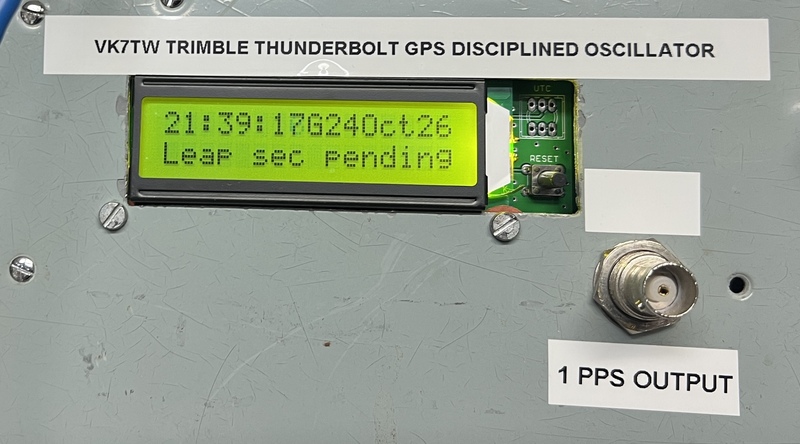
Time's Up for the Leap Second! A Historic Decision With Implications for Amateur Radio
Date :
27 /
10 /
2026
Author :
BIPM & WIA
After more than 50 years of occasionally adding an extra second to the world's clocks, international timekeepers have decided that the leap second has had its day. For radio amateurs, particularly those involved in digital modes, satellite communications and precision frequency measurement, the decision has some interesting implications.
On 15 October 2026, the General Conference on Weights and Measures (CGPM), meeting in Paris, adopted a resolution to move Coordinated Universal Time (UTC) to a continuous time scale.
The decision, made under the auspices of the International Bureau of Weights and Measures (BIPM), means the current practice of inserting leap seconds to keep atomic time closely aligned with the Earth's rotation will be discontinued.
The change takes effect on 20 May 2027.
It marks a significant development in international timekeeping and recognises the increasingly important role that accurate, continuous time plays in modern communications, computing, navigation and scientific measurement.
What Is a Leap Second?
We tend to think of a day as exactly 86,400 seconds, but the Earth doesn't rotate with the precision of an atomic clock.
Its rotation varies slightly because of factors including movements within the Earth's core, atmospheric circulation, ocean tides and changes in the distribution of mass across the planet.
Atomic clocks, meanwhile, measure time using extremely stable atomic transitions.
Since 1972, leap seconds have occasionally been inserted into UTC to keep it within 0.9 seconds of UT1, a time scale based on the Earth's rotation.
A positive leap second creates the unusual sequence:
23:59:58 → 23:59:59 → 23:59:60 → 00:00:00
Since the system began, 27 positive leap seconds have been introduced, with the most recent occurring on 31 December 2016.
However, recent variations in the Earth's rotation have raised the possibility that a negative leap second, where a second is removed rather than added, might eventually be necessary.
Such an adjustment has never been implemented and presents additional challenges for computer systems.
Why Get Rid of Leap Seconds?
The modern world depends on extremely accurate and consistent time.
Telecommunications networks, satellite navigation systems, financial transactions, electricity networks and distributed computing systems all rely on synchronised clocks.
Unfortunately, not every computer or network handles leap seconds in the same way.
Some systems insert the extra second directly, while others gradually adjust their clocks using a technique known as leap smearing.
These different approaches can create inconsistencies between systems that are supposed to share a common time reference.
The CGPM's decision is intended to eliminate these discontinuities and provide a more predictable international time standard.
From May 2027, the permitted difference between UTC and UT1 will increase from 0.9 seconds to 3,600 seconds, or one hour.
That does not mean our clocks will suddenly change by an hour. It simply allows atomic time and Earth-rotation time to diverge gradually without requiring frequent corrections.
The difference between UTC and UT1 will continue to be monitored and published for scientific applications that need it.
Why Does This Matter to Amateur Radio?
Amateur radio operators may not think about atomic clocks every day, but accurate timing is fundamental to many of the technologies we use.
1. FT8, FT4, WSPR and Other Weak-Signal Modes
Modern weak-signal digital modes rely on accurately synchronised transmission and reception periods.
FT8, for example, uses 15-second transmission sequences, while FT4 uses shorter 7.5-second sequences.
If computer clocks are sufficiently out of synchronisation, stations may have difficulty decoding one another.
The removal of leap seconds reduces one potential source of timing discontinuities, although operators will still need reliable clock synchronisation.
2. GPS-Disciplined Oscillators and Frequency Standards
Many amateur experimenters use GPS-disciplined oscillators (GPSDOs) to provide highly accurate 10 MHz reference signals.
These references are particularly valuable for microwave experimentation, frequency measurement, transverters and weak-signal communications.
GPS time is continuous and does not itself insert leap seconds, although GPS receivers provide information allowing conversion to UTC.
The new arrangement simplifies the long-term relationship between continuous timekeeping systems, but equipment that converts between GPS time and UTC must still be correctly configured.
3. Software Defined Radio and Digital Signal Processing
SDR systems increasingly depend on accurate timestamps, synchronised sampling and precisely timed signal processing.
Applications involving multiple receivers, coherent signal processing and distributed monitoring networks can be sensitive to timing inconsistencies.
A continuous UTC time scale provides a more predictable foundation for these systems.
4. Amateur Satellites and EME
Satellite tracking involves precise calculations of orbital position, Doppler shift and antenna pointing.
Earth-Moon-Earth communications also require careful attention to Doppler compensation and frequency stability.
Although leap seconds are not usually a major obstacle for everyday amateur satellite operation, removing time discontinuities simplifies aspects of the software and timing infrastructure supporting these activities.
Importantly, precise astronomical calculations will still need to account for the difference between UTC and UT1.
5. Amateur Radio Networks and Emergency Communications
Amateur radio increasingly uses networked repeaters, digital voice systems, APRS, internet-linked services and remotely controlled stations.
These systems often depend on synchronised computers and network infrastructure.
Continuous UTC should reduce the risk of timing anomalies caused by leap-second adjustments, although it does not eliminate the need for reliable clocks, resilient networks or independent communications capabilities.
Will Radio Amateurs Need to Change Anything?
For most operators, no immediate action is required.
Computer clocks, GPS receivers, NTP servers and modern operating systems should continue to provide the time needed for normal amateur radio activities.
However, experimenters operating specialised timing equipment, older GPS receivers, custom NTP servers or software that explicitly processes leap-second announcements should review manufacturer and software guidance as the May 2027 transition approaches.
Operators using FT8, FT4 and WSPR should continue to maintain accurate UTC synchronisation.
And for those interested in precision timing, the change provides an excellent opportunity to explore the fascinating relationship between atomic clocks, GPS time, UTC and the Earth's rotation.
Time Marches On, Without the Extra Second
The leap second was introduced when international timekeeping was very different from today's highly interconnected digital world.
More than half a century later, the demands of modern communications and computing have led to its retirement.
For amateur radio, the decision reinforces just how important accurate time and frequency standards have become to our hobby.
From a simple FT8 contact to a sophisticated microwave experiment, precise timing is often an essential ingredient.
The Earth may continue to wobble and change its rotation rate, but from May 2027 our UTC clocks will no longer need to stop for an occasional extra second.
Sources and Further Reading
BIPM: Resolution 5 of the 28th CGPM (2026), Continuity of UTC
Link
BIPM: 2026 CGPM Resolutions
Link
National Physical Laboratory: The Future of Timekeeping
Link
Timeanddate.com: The World Abandons Leap Seconds
Link
International Earth Rotation and Reference Systems Service
Link
WSJT-X: Weak-Signal Amateur Radio Software
Link
Wireless Institute of Australia
Link
Source acknowledgement: The international timekeeping decision is based on Resolution 5 adopted by the CGPM on 15 October 2026, with supporting information from the BIPM, the UK's National Physical Laboratory and timeanddate.com. The discussion of amateur radio applications is additional technical commentary.
Page Last Updated: Monday, 26 Oct 2026 at 17:29 hours by Justin Giles-clark
Click Here To Return To Previous Page
|