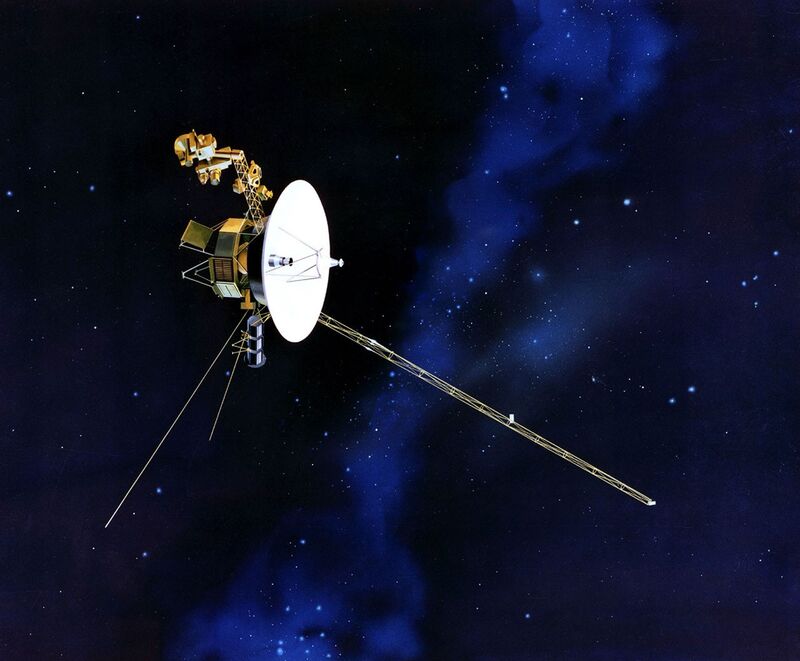
Voyager 1: One Light-Day From Earth! Celebrate With a Flash of Morse Code
Date :
16 /
11 /
2026
Author :
NASA
The most distant human-made object in history is approaching another extraordinary milestone, and NASA is inviting the world to celebrate with a little Morse code!
Launched on 5 September 1977, Voyager 1 has travelled farther from Earth than any other spacecraft. Nearly half a century later, it continues its remarkable journey through interstellar space, carrying humanity's scientific instruments and famous Golden Record into the unknown.
Voyager 1 is approaching a distance of one light-day from Earth. That's approximately 25.9 billion kilometres, so far away that even a radio signal travelling at the speed of light takes 24 hours to reach the spacecraft.
For radio amateurs, that is an astonishing example of the distances involved in deep-space communications. A message sent to Voyager 1 at that distance would take approximately 48 hours for a reply to return, assuming an immediate response.
Shine Bright for Voyager's Light-Day!
NASA is inviting people around the world to participate in a special celebration on Tuesday 17 November 2026, using one of amateur radio's oldest and most recognisable communications techniques: Morse code!
Participation is simple:
Step outside after sunset in your local time zone.
Point a torch, lantern, phone screen or another light source towards the night sky.
Flash the spacecraft's three-letter call sign, VGR, in Morse code.
Alternatively, use NASA's online automatic flasher to display the pattern on your screen.
What Is VGR in Morse Code?
V: · · · −
G: − − ·
R: · − ·
In traditional Morse notation:
VGR = ...- --. .-.
It's a simple symbolic salute to one of humanity's greatest scientific achievements.
From Voyager to V'Ger!
Science fiction fans might recognise a familiar connection.
In the 1979 film Star Trek: The Motion Picture, a fictional Voyager space probe becomes known as V'Ger, providing a memorable link between real-world space exploration and science fiction.
NASA's VGR abbreviation is genuine spacecraft engineering shorthand, but the similarity provides another reason for radio amateurs and science fiction enthusiasts to enjoy the celebration.
A Remarkable Achievement in Radio Communications
Voyager 1's continuing operation is also a tribute to the extraordinary achievements of deep-space radio engineering.
Its faint signals are received through NASA's Deep Space Network, using enormous, highly sensitive antennas and sophisticated signal-processing techniques.
For radio amateurs interested in weak-signal communications, EME, SDR, precision frequency control and antenna engineering, Voyager provides a fascinating demonstration of what is possible when radio technology is pushed to its limits.
On 17 November, why not step outside, look towards the stars and send a little Morse code into the night sky?
A fitting tribute to a spacecraft that has been exploring the universe since 1977.
Further Information
NASA: Shine Bright for Voyager's Light-Day
Link
NASA: Voyager Mission
Link
NASA: Deep Space Network
Link
Image sourced from NASA Archives.
Source acknowledgement: NASA Voyager Mission and the NASA “Shine Bright for Voyager's Light-Day” campaign.
Page Last Updated: Sunday, 15 Nov 2026 at 22:29 hours by Justin Giles-clark
Click Here To Return To Previous Page
|